Most beauty brands are built around desire. They promise transformation, sell aspiration, and compete loudly for attention. Aesop built its entire brand on the opposite premise and became one of the most studied identity systems in modern branding as a result.
Founded in Melbourne in 1987, Aesop is technically a skincare company. Strategically, it’s something more specific: a lifestyle philosophy delivered through daily ritual. Understanding why it works requires looking not at what Aesop does, but at what it consistently refuses to do.
The Category Tension It Exploited
Skincare is a loud, overcrowded category — trend-driven, emotionally manipulative, and visually excessive. Brands compete on promises that escalate constantly: faster results, more actives, bigger claims, louder packaging.
Aesop identified a consumer who was exhausted by all of it.
Their target isn’t defined by income bracket or age. It’s defined by a mindset: urban, design-literate, aesthetically discerning, and deeply resistant to feeling marketed to. These are people who find most beauty advertising faintly insulting. They want products that work, presented without theatre.
This is the tension Aesop sits inside and it’s a precise one. Not “luxury vs mass” or “natural vs synthetic.” It’s the gap between consumers who want to be spoken to as intelligent adults and a category that largely doesn’t.
What They Built Instead
Aesop’s brand identity is one of the most coherent systems in contemporary retail, not because it’s visually distinctive, though it is, but because every element of it expresses the same underlying idea.
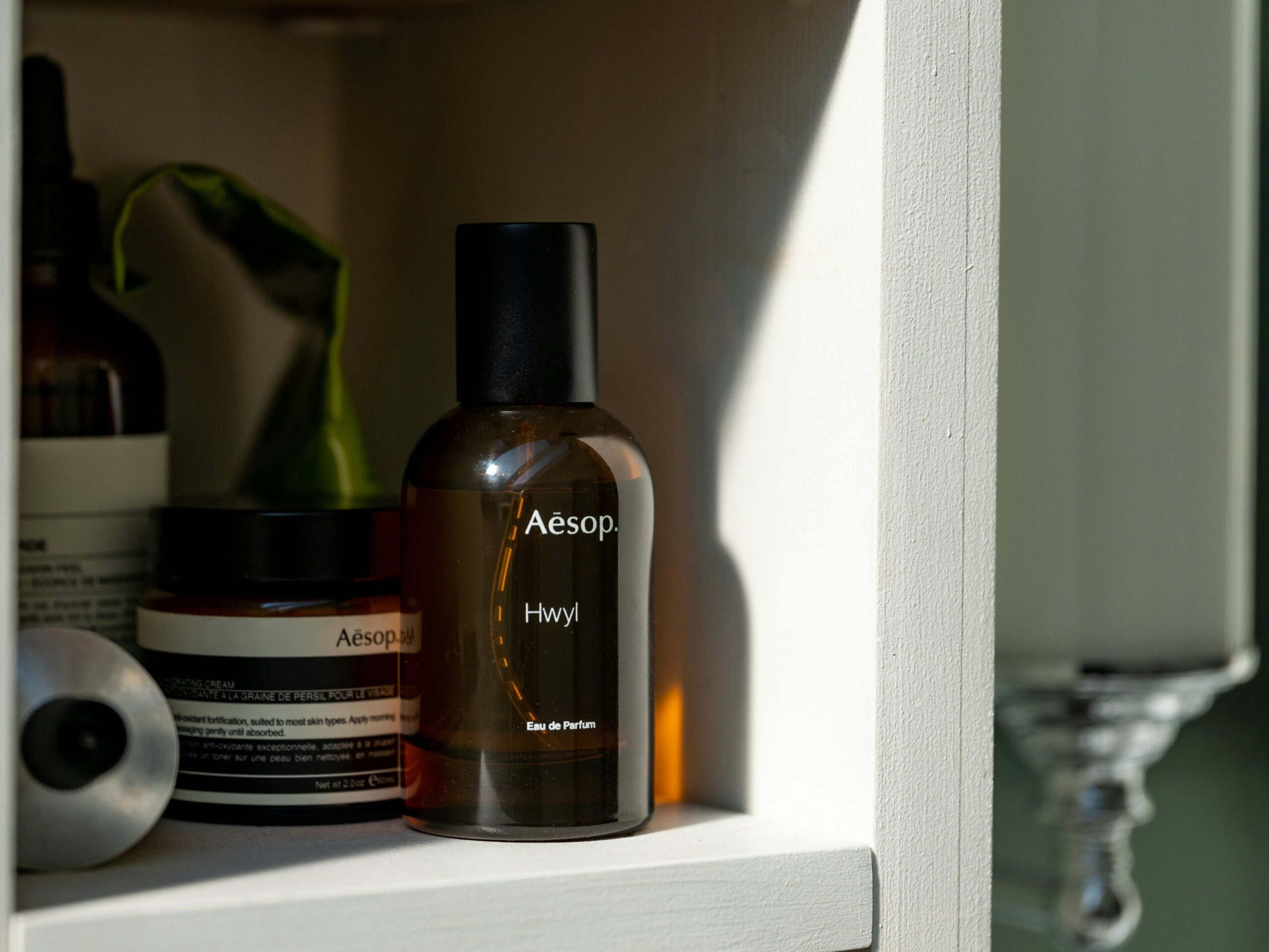
The amber bottles with clinical typography, the monochrome palette, the layouts that reference scientific journals — none of this is aesthetic for its own sake. It signals precision, seriousness, and the absence of vanity. The visual language says: we are not trying to seduce you. That restraint, for their specific audience, is more seductive than anything else could be.
The verbal identity follows the same logic. Aesop writes in long, considered sentences. They reference philosophy, poetry, and humanism. They avoid beauty clichés entirely. Where another brand might say “your skin will glow in 7 days,” Aesop recommends “a considered skincare routine that values consistency and knowledge of one’s unique skin.” The difference isn’t just tone — it’s a fundamentally different relationship with the customer. One talks at you. The other talks with you.
This extends into how their stores behave. Aesop doesn’t train staff to sell — it trains them to consult. Service is unhurried, non-intrusive, and ritual-led. Customers are guided through sensory experience rather than pushed toward a transaction. The result is that buying something feels incidental to the visit, which paradoxically makes people want to buy.
The Retail Strategy As Brand Strategy
Aesop’s stores are where their brand philosophy becomes most tangible and most strategically interesting.
Every store is designed by a different architect, using materials specific to its location. A Tokyo store might use warm timber. A Paris store might use limestone. A Seoul store might use stainless steel and curved geometry. No two look alike, yet all of them feel unmistakably like Aesop. The coded values — quietness, material honesty, sensory warmth, the absence of urgency — remain constant even as the form changes entirely.
This is a sophisticated brand manoeuvre. Aesop appears global without feeling generic. They achieve local cultural relevance without fragmenting their identity. And because each store generates its own architectural press coverage, they grow their cultural footprint without spending on traditional advertising.
The store isn’t a distribution point. It’s the brand’s primary communication channel.
Growth Without The Usual Playbook
Aesop’s expansion followed none of the standard beauty industry logic. No celebrity endorsements. No influencer campaigns. No promotional discounts. No aggressive scaling into mass retail.
Instead they entered markets through creative communities first — design-forward neighbourhoods, architect circles, cultural tastemakers. They let credibility build before reach expanded. This sequencing matters: most brands chase scale and hope credibility follows. Aesop inverted that, which is why their premium pricing holds and their brand equity compounds rather than dilutes over time.
Their restraint in marketing is not modesty — it’s strategy. In a category defined by noise, silence is differentiation. Every brand that isn’t Aesop is fighting for the same attention. Aesop opted out of that fight entirely and built something more durable: cultural authority.
What This Case Study Actually Teaches
Aesop is not interesting because it’s minimal or because its stores are beautiful. It’s interesting because it identified a specific consumer tension — intelligent people who feel condescended to by beauty marketing — and built every single brand element in response to that tension, without exception and without compromise.
The lesson for brand strategy isn’t “be quiet” or “use amber bottles.” It’s that consistency of worldview, applied across every touchpoint, creates a kind of brand coherence that advertising budgets can’t replicate. Aesop’s moat isn’t its formulations or its design. It’s the fact that every interaction with the brand — visual, verbal, spatial, sensory — says exactly the same thing.
That’s rare. And it’s what makes it worth studying.