Brand Snapshot
Category: Premium skincare & personal care
Founded: 1987, Melbourne
Positioning: Intellectual, minimalist, sensorial luxury
Archetype: The Sage (with touches of Caregiver)
Tagline: None — Aesop avoids slogans intentionally
Brand Idea: “Thoughtful formulations, delivered without exaggeration.”

Why Aesop Became a Branding Icon
Most beauty brands try to excite the customer.
Aesop tries to calm them.
In a category full of noise — Aesop created quiet authority.
Their brand success comes from 3 strategic decisions:
1. Anti-beauty marketing in a vanity-driven category
No glamour, no models, no heavy emotional advertising.
2. Philosophical, intellectual tone of voice
They treat customers as equals, not consumers.
3. Architecture-led brand identity
Store design → product design → visual identity → uniformity.
This psychological contrast is why they stand out.
Brand Positioning
Category Insight
Skincare is overcrowded, trend-based, visually loud, and emotionally manipulative.
Audience Insight
Aesop targets:
- Urban professionals
- High-income, high-aesthetic consumers
- People who appreciate design, architecture, literature
- Consumers who reject “beauty perfection pressure”
- People who prefer experiential luxury over flashy labels
Core Consumer Tension
“I want products that work, without feeling marketed to.”
Brand Promise
Honesty, efficacy, and intellectual calm in a chaotic beauty world.
Value Proposition
Scientifically-grounded formulations delivered with design simplicity and sensory richness.
Archetypes & Personality
Primary Archetype: The Sage
- calm
- thoughtful
- precise
- knowledgeable
- observational
- grounded
Secondary Notes: The Caregiver
- gentle
- nurturing
- warm
- supportive
Brand Personality
- Minimal
- Unhurried
- Scholarly
- Aesthetic
- Considered
- Understated
Aesop’s power = consistency of this personality across product, retail, communication, and service.
Aesop’s Identity System
Aesop built one of the strongest identity ecosystems in modern branding.
Visual Identity
- Monochrome color palette
- Scientific, spaced type (Söhne / Optima style)
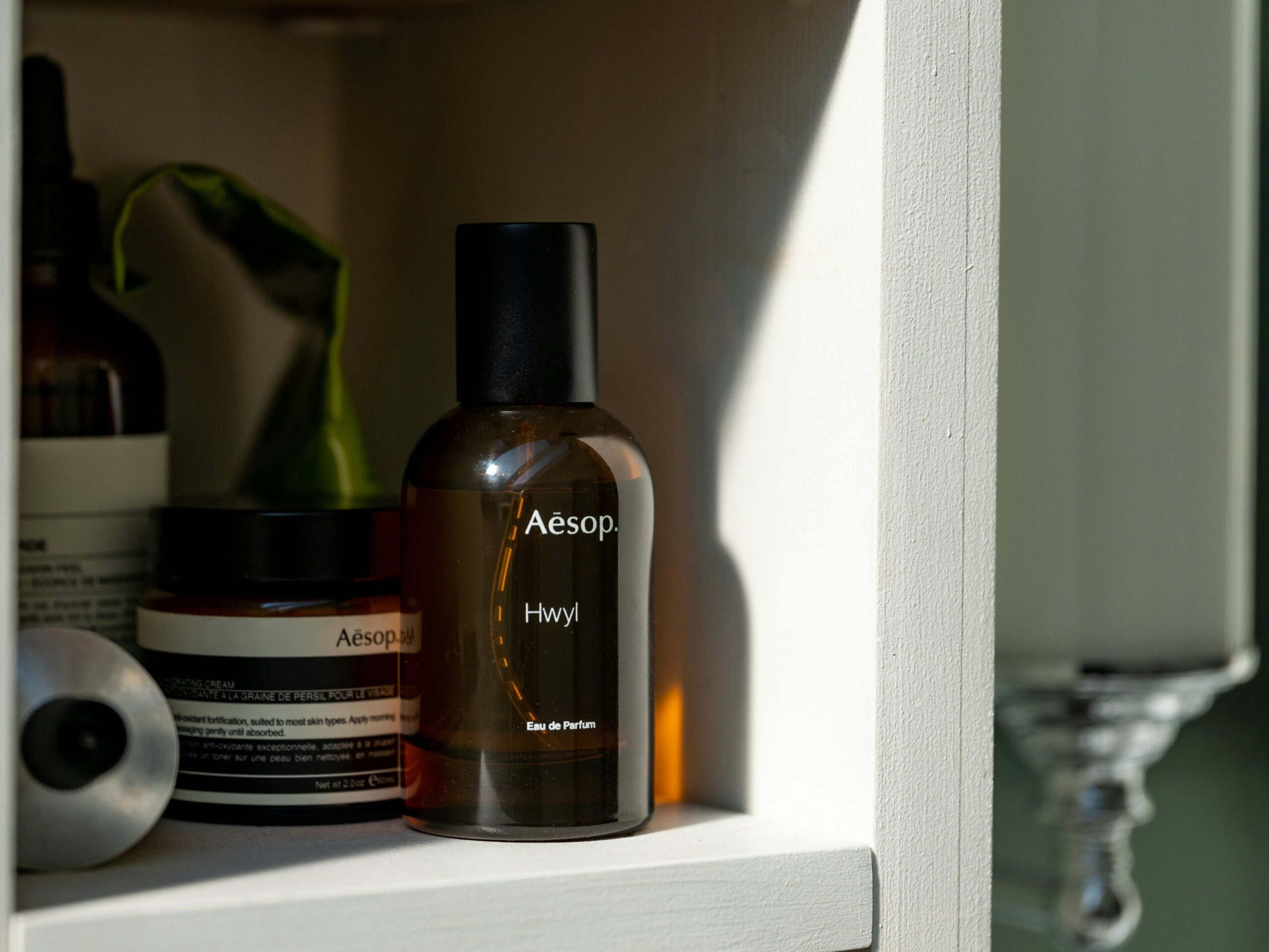
- Amber bottles with clinical labels
- No photography of faces
- No glamorous visuals
- Layouts that resemble scientific journals
Verbal Identity
- Long, literary sentences
- References to philosophy, poetry, humanism
- Avoidance of beauty clichés
- Warm yet non-emotional tone
- Never salesy
Sensory Identity
- signature essential oil scents
- calm, warm lighting
- tactile rituals in stores
Behavioral Identity
- consulting, not selling
- slow-paced service
- intentional silence
- ritual-based sampling
Identity = not just how Aesop looks,
but how Aesop behaves.
Aesop’s Store Strategy (Brand Differentiator)
Aesop stores are miniature spatial identities, each one unique but following a code.
Brand Codes in Retail
- warm lighting
- scent diffused constantly
- materials inspired by local geography
- bookshelf & literature corner
- no bright color distractions
- no sales vectors (no discounts, no urgency)
Why This Works
Because the store becomes:
- a sensory ritual
- a design pilgrimage
- an extension of brand values
- a cultural destination
Customers feel like they’re entering a sanctuary, not a store → which creates brand bonding.
Communication Strategy
Aesop does not advertise traditionally.
No influencer marketing
No beauty campaigns
No vanity messaging
Instead they rely on:
- Experiential retail
- Architectural partnerships
- Literature & culture collaborations
- PR around stores
- Word-of-mouth
This creates cultural capital, not commercial noise.
Brand Tone Example
Instead of saying:
“Your skin will glow in 7 days.”
They say:
“We recommend a considered skincare routine that values consistency and knowledge of one’s unique skin.”
This makes Aesop feel like a mentor, not a seller.
Competitor Analysis (Strategic View)
Loud Beauty Brands
Sephora, Glow Recipe → hyper-aesthetic, trend-based
Aesop → quiet, slow, anti-trend
Luxury Brands
Le Labo → sensory, industrial
Aesop → sensory, intellectual
Clinical Brands
The Ordinary → science-forward, minimal
Aesop → science + design + philosophy
Aesop sits at the intersection of:
Science × Sensory × Culture.
Brand Narrative
Every great brand has a narrative system that shapes perception.
Aesop’s Core Narrative:
“Life is chaotic. Our rituals help you return to yourself.”
It has 3 layers:
1. Ritual
Daily routines → calm, grounding
2. Reflection
Literary tone → inner contemplation
3. Care
Gentle products → self-preservation
This narrative shows up in product names, packaging copy, store experience, and retail rituals.
What Aesop Does Not Do (And Why It Works)
No before-after photos
No celebrity endorsements
No clinical claims like “reduces acne 129%”
No social media trends
No inconsistent fragrance-driven drops
No promotional discounts
No “clean beauty” moralizing
Their restraint IS their strategy.
In a loud category, silence creates power.
Aesop’s Growth Strategy
Aesop’s expansion never followed the traditional beauty playbook.
There were no celebrity endorsements, aggressive promotions, or hyper-growth tactics.
Instead, Aesop grew through architecture, culture, and consistency of worldview.
Below is a more detailed breakdown of the five pillars of their growth strategy.
1. Expanding Through Architecture, Not Advertising
Aesop’s most influential marketing channel is its stores.
Each store is treated as a site-specific cultural installation—designed with local materials, local architects, and a unique interior narrative.
This approach delivers three growth advantages:
- Organic press: Architecture and design publications cover every new store.
- Cultural relevance: Stores become local landmarks, not commercial units.
- Low paid-media dependency: Aesop relies on environments, not ads, to tell its story.
Their retail spaces function as brand temples.
People don’t visit Aesop to buy; they visit to experience the brand.
2. Premium Pricing With Slow, Intentional Expansion
Aesop resisted the industry pressure of rapid scaling.
Instead, they grew slowly and priced confidently.
The brand understands that:
- slowness = intention
- intention = perceived quality
- perceived quality = pricing power
Aesop’s pace of expansion reinforces its luxury positioning.
The brand never appears mass, rushed, or diluted—because it never tries to be everywhere.
3. Culturally Intelligent Market Entry
Aesop enters markets through culture first, commercial scale second.
Their expansion pattern is consistent:
- Start in niche, design-forward neighbourhoods
- Build credibility in architect and creative circles
- Create cultural buzz
- Let mainstream adoption follow naturally
By anchoring themselves in creative communities, Aesop becomes a cultural marker — not just a personal care brand.
They expand through taste-makers, not mass media.
4. Global But Hyper-Local Interior Design
Aesop mastered the paradox of being globally recognizable while looking different everywhere.
Every store shares the same coded values:
- quietness
- ritual
- material honesty
- sensory warmth
But the form is always unique.
A Tokyo store may use warm timber,
a Paris store may use limestone,
a Seoul store may use stainless steel and curved lines.
The result:
- Aesop feels the same everywhere
- yet no two stores look alike
This balance of global coherence and local specificity is a signature growth lever few brands execute as well.
5. Sensory-Led Customer Experience
Aesop treats customer service as craft.
Their retail ritual includes:
- unhurried, attentive conversation
- product trials guided by smell, texture, and sensorial detail
- gentle, non-intrusive selling
- a calm soundscape & considered lighting
- botanical storytelling woven subtly into the experience
This sensory approach becomes a competitive moat.
Customers don’t just buy a cleanser —
they buy a small moment of calm.
In a world engineered for speed,
Aesop wins by engineering stillness.
Lessons for Brand Strategists
Aesop teaches four critical lessons:
1. Consistency beats creativity
They repeat the same philosophy everywhere.
2. A brand can win by being the opposite
Anti-beauty → authority
Anti-noise → desirability
Anti-hype → longevity
3. Identity is a system, not a logo
Every sensory element matters.
4. Culture moves forward, but rituals stay timeless
That’s why Aesop feels modern AND classic.
What Makes Aesop… Aesop (Summary)
| Brand Element | Aesop’s Signature Moves |
| Positioning | Philosophical, sensory luxury |
| Archetype | Sage / Caregiver |
| Tone | Intellectual, calm, unhurried |
| Visuals | Amber bottles, monochrome, minimal typography |
| Retail | Architectural sanctuaries |
| Marketing | Culture > advertising |
| Experience | Ritual-driven, slow service |
| Differentiation | Silence in a loud industry |
Final Strategic Insight
Aesop is not a skincare company.
Aesop is a lifestyle philosophy delivered through skin rituals.
This is the core of their brand power.